
In refrigeration systems, copper tubes are one of the most commonly used pipes. Copper tubes have the advantages of good thermal conductivity,
high strength, good plasticity, and corrosion resistance. They are widely used in heat exchange components such as condensers and evaporators,
as well as connecting pipes. This article will elaborate on the classification of copper tubes, technical requirements for copper tubes for refrigeration, and calculation of copper tube wall thickness.
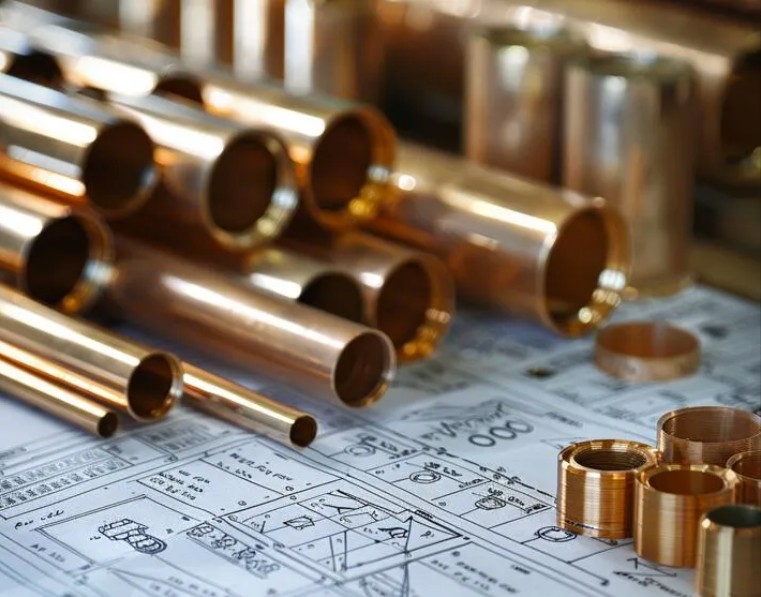
I. Classification and performance characteristics of copper tubes
1. According to material composition:
Copper tubes can be divided into red copper tubes (TP2), brass tubes (H62/H65/H68), bronze tubes (QSn6.5-0.1),
nickel silver tubes (Ni-Cu alloy), etc. Among them, red copper tubes have the best thermal conductivity, but are more expensive; brass tubes have high strength,
but low thermal conductivity; bronze tubes and nickel silver tubes have good corrosion resistance, but poor processing performance [1].
2. According to production process:
Copper tubes can be divided into oxygen-free copper tubes, oxygen-containing copper tubes, internally threaded copper tubes, etc.
Oxygen-free copper tubes are of high purity and are generally used to make precision parts such as capillaries;
oxygen-containing copper tubes have moderate strength and hardness, good weldability, and are mostly used as connecting tubes;
internally threaded copper tubes have threads on the inner wall, which has a good effect of enhancing heat transfer [2].
3. According to hardness:
Copper tubes can be divided into three categories: soft state (O state), semi-hard state (1/2H), and hard state (H state).
O-state copper tubes are soft, with good plasticity and ductility, but low strength; H-state copper tubes have high strength and hardness, but poor plasticity;
1/2H copper tubes have moderate strength and plasticity, good processing performance, and are the first choice for refrigeration pipelines [3].
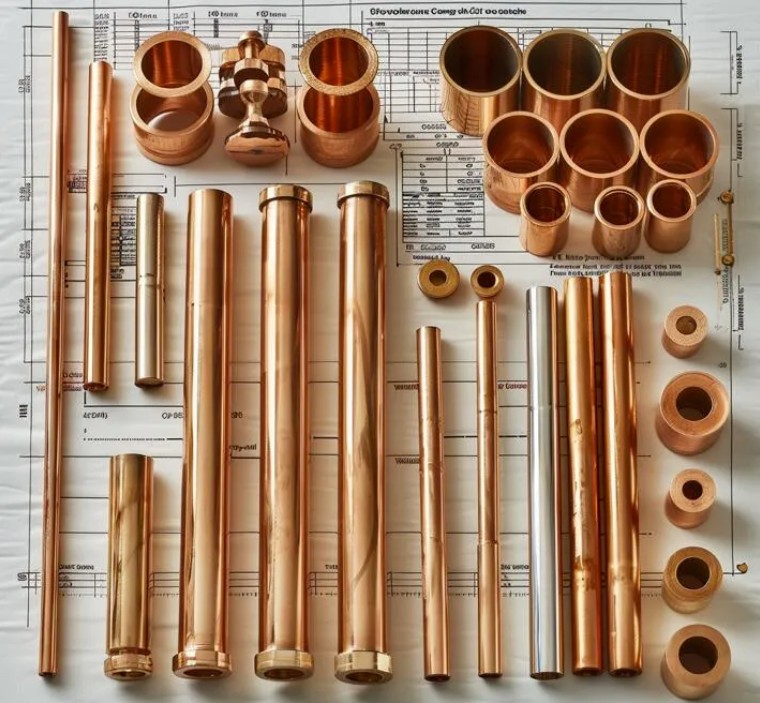
II. Technical requirements for copper tubes used in refrigeration systems
1. Material requirements
The refrigeration system mostly uses 1/2H copper tubes (TP2M), and its chemical composition should comply with the provisions of GB/T 17505-2010 [4]:
Cu+Ag≥99.90%
0.015%≤P≤0.040%
The content of impurity elements should meet the following requirements: Bi≤0.001%, Sb≤0.002%, As≤0.002%, Fe≤0.005%, Pb≤0.005%, S≤0.005%, Zn≤0.005%, Ni≤0.002%, Sn≤0.002%.
2. Mechanical properties
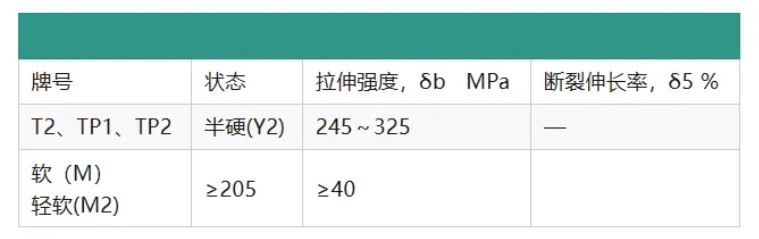
The mechanical properties of 1/2H copper tubes shall meet the following requirements [4]:
Tensile strength Rm ≥ 295MPa
Yield strength Rp0.2 ≥ 255MPa
Elongation after fracture A ≥ 3%
Table: Room temperature mechanical properties of tubes
3. Dimensional deviation
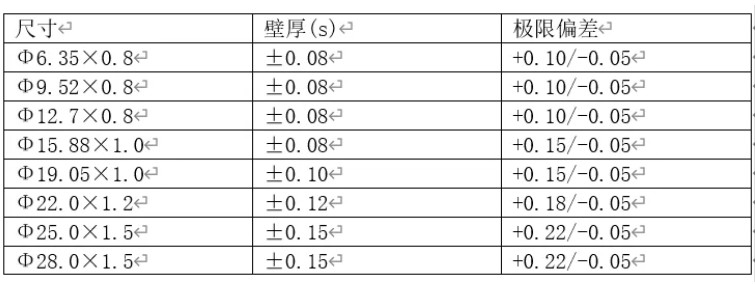
The limit deviation of the outer diameter (D) and wall thickness (s) of copper tubes shall comply with the provisions of Table 1 [5].
The meter weight (M) is calculated according to the formula M = 0.02566·D·s [6], and the deviation should be within ±8%.
Table: Bare copper tube dimensions and deviations (mm)
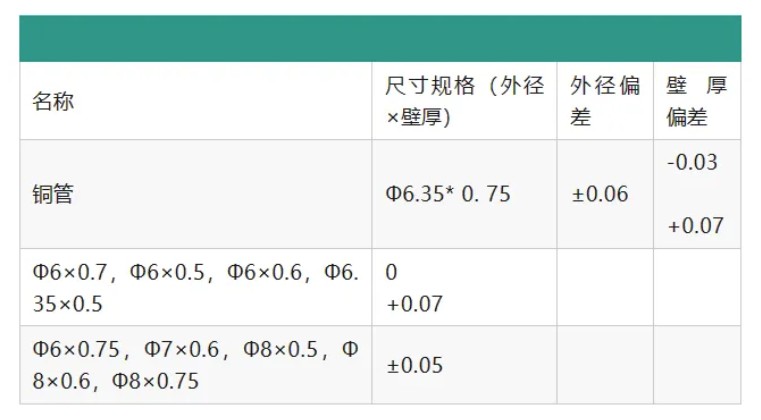
Table 1/2H-state copper tube dimension limit deviations (mm)
III. Copper tube wall thickness calculation method
1. Pressure vessel specification method
According to the ASME pressure vessel specification, the minimum wall thickness of a copper tube under internal pressure can be calculated as follows [7]:
t=PD/(2S+0.8P)
Where: t-minimum wall thickness (mm), P-design pressure (MPa), D-pipeline outer diameter (mm), S-allowable stress of the copper tube (MPa),
which can generally be taken as 1/3~1/4 of the yield strength of the copper tube.
2. Fluid mechanics method
Taking into account the pressure loss during fluid flow, the wall thickness of the copper tube should also meet the fluid mechanics strength condition [8]:
t=D·(3ξρv^2/8σ[s])^0.5
Where: ξ-drag coefficient along the way, which is related to the Reynolds number and relative roughness; ρ-refrigerant density (kg/m³);
v-refrigerant flow rate (m/s); σ[s]-allowable shear stress of the copper tube (MPa), which can be taken as 1/3 of the yield strength.
3. Vibration fatigue method
Copper tubes in refrigeration systems are often subjected to alternating stress, and vibration fatigue strength needs to be verified [9]:
σ[a]=Cf·σ[-1]·(2N[f])^m≤[σ]
Where: σ[a]-alternating stress amplitude (MPa), Cf-surface quality coefficient, σ[-1]-fatigue limit of copper tube material (MPa),
take 0.40.5 of yield strength, Nf-fatigue life (times), m-fatigue strength index, take 34, [σ]-allowable alternating stress (MPa), take 0.6~0.7 of yield strength.
The minimum wall thickness required can be estimated from this.
In order to ensure the safety and reliability of copper tubes under harsh working conditions such as high temperature, high pressure and vibration,
the design should generally be calculated according to the above three methods, and the maximum value should be selected as the nominal wall thickness of the copper tube.
IV. Conclusion
The selection and design of copper tubes for refrigeration systems is a systematic project, which requires comprehensive consideration of many factors such as materials,
processing, connection, installation, and use. During the design, the material, state, and specifications of the copper tube should be reasonably selected according to the system's cooling capacity,
working fluid, temperature, pressure and other parameters. The determination of the copper tube wall thickness requires verification and calculation from the aspects of pressure bearing capacity,
fluid resistance, vibration fatigue, etc. to ensure the safety, reliability and economy of the system.
It should be pointed out that the wall thickness calculation formula given in this article is for reference only.
In actual design, the influence of factors such as the copper tube bending radius, support spacing, and connection method should also be considered.
Designers should keep abreast of the latest standards and technological developments of copper tubes and pipe fittings, improve design methods,
and improve design quality. At the same time, it is necessary to strengthen the control of the construction process, strictly follow the specifications for copper tube transportation,
storage, processing and connection, and system installation and commissioning, so as to ensure the safe and efficient operation of the refrigeration system.
 The difference between No. 1 copper and Grade A copper! If you don't understand, you are not worthy of being a copper industry person
 Refrigeration system: How to choose and design copper tubes?
 Why can't brass be used for busbars? Why are the terminals made of brass?
 Copper Market Outlook: Significant Bullish Potential in the Second Half of the Year
 The trend of Shanghai copper is still volatile, and the spot copper price is under pressure and slightly increased.
- An indispensable high-performance alloy in the electrical industry - chromium-zirconium copper
Chat Online